3.2.15

What’s New On Aesthetic Horizons? — Permanent Eye Color Change


Blue Eyes with Laser Treatment
Not up for wearing contact lenses and yet craving baby blue eyes, now modern medicine can do that for you. Yup, a few 20 second treatments with a special laser can sweep the brown pigment out of your iris revealing piercing blue eyes in just under two weeks. The big catch is - the procedure is relatively new, side effects not widely studied and the results are irreversible and permanent. It will take few years to get the safety studies conducted and published, but despite all that it’s a major break through in aesthetic medicine and a remarkable choice to have — permanently blue eyed, oh boy!

The anatomical reality of our peepers is that under every brown eye there is a blue hidden, the only difference between a brown eye and a blue eye is a very thin layer of pigment on the surface. If we take that pigment away, then the light as it enters the stroma and gets scattered, it’d only reflect back the shortest of wavelengths and that's the blue end of the spectrum — just like the ocean.

Clinical Trials

A California-based company Strōma Medical is investigating this melanin-targeting laser technology to break down pigment on the outer layers of the iris to deliver permanent blue eyes. So far, just 17 patients in Mexico and 20 in Costa Rica have undergone the treatment with on long term side effects reported. Clinical trials are being conducted outside USA as FDA clearance is still pending.

In Spain NewEyes Laser of EYECOS has been offering the procedure to the public for two years now. They claim that the laser treatment for rinsing eye color is a safe treatment and has been performed in more than 300 cases of people from more than 30 countries worldwide.

One unique factor that separates NewEyes Laser from Strōma Laser is that New Eyes in Spain has been offering its clientele a choice of hazel and green in addition to the blue color to choose from, while Stroma is only promising the bluest of the blue.

How Does The Treatment Work?
Laser for blue eyes

The basic idea has been borrowed from aesthetic doctors who use lasers to remove excess pigmentation from the skin. In the case of changing eye color, simply removing the brown pigment is enough to do the trick because as we know now that blue eyes are not blue at all, just as the sea is not full of blue water — it’s a trick of perception caused by scattered light. A blue iris is simply an iris without color.

What’s Stopping The Procedure To Be Worldwide?

Safety Concerns obviously, the effectiveness of the procedure, which is likely to be irreversible, seems to be proven however, the jury is still out as to whether it will pass the safety tests. Once it gets the FDA safety approval, then major safety questions would be answered and the medical community will have more faith in the procedure to back it up.

So far ophthalmologists have voiced glaucoma and cataracts as a risk factors with such a treatment. The laser companies working on the pre-clinical trial and early clinical trials are confident so far that such lasers will not do harm because of the low energy used and the fine particle size of the broken up pigment but, when it comes to one's eyesight, there is no room for assumptions.

The biggest concern raised by most ophthalmologists has been breaking the pigment and releasing pigment inside the eye — the pigment potentially can clog up the normal drainage channels which can in turn cause the pressure inside the eye to rise up. If that happens significantly enough, for long enough, you can develop glaucoma after such an intervention. To answer this concern Stroma Medical has claimed that the particles released by the process are too fine to cause glaucoma and that any complications were likely to be short-term and easily remedied — but a risk still remains. Theory has some sense to it, but without seeing long-term outcomes and without seeing a big cohort of patients that have been treated in this way most ophthalmologists are sitting on the fence and are not backing the laser generated blue eyes yet.

Just in case you were wondering how much does it cost to turn those brown eyes into that piercing blue gaze, Stroma Medical is currently charging around $5,000 (£3,120) for the procedure. NewEyes Laser is offering it for €2,000.

Only 17% of the world population has blue eyes — question is would to like to increase that number if all safety questions are answers to the authorities satisfaction?

27.1.15

Looking At Potatoes With New Eyes — Hello Ultimate Diet Food


Potatoes help with weightloss
Potato a starch rich vegetable has always been considered something of an anti-diet food, but new ground breaking research results from McGill University are going to change the way we judge our side order of French fries or baked/mashed potatoes. According to this interesting study published in the journal of “Molecular Nutrition & Food Research”, high potato consumption in mice led to decrease weight gain when fed on obesity-triggering diet. The research team has concluded that the high concentration of polyphenols in potatoes might be responsible for this weight retarding action.

Slimming Power Of Tuberous Spuds

Polyphenols — a disease-fighting chemical component found in fruits and vegetables helps prevent the body from absorbing glucose and converting it into fat. Potatoes reportedly are a richer source of polyphenols even more so than the popular sources like blueberries or green tea.

In the study, a special variety of mice prone to weight gain were fed a diet with more than 60 percent of calories coming from saturated fat. One group of mice were also fed polyphenol-rich extract derived from Russet Burbank and Onaway potatoes, weight gain was reduced by as much as 63 percent — even among mice that consumed the largest quantities of saturated fat.

Mice that started out weighing on average 25 grams put on about 16 grams. Meanwhile, mice that consumed the same diet but with a potato extract gained much less weight: only 7 more grams. This study brilliantly shows us that a simple potato extract may limit weight gain from a diet that is high in fat and refined carbohydrates.

The control group in this research showed no health benefit among any mice when synthetic versions of the top four polyphenols in potatoes were substituted for the extract.

The daily dose of extract in the study came from 30 potatoes, the research team doesn’t advise anyone to eat 30 potatoes a day (because that would be an enormous number of calories). The McGill team is suggesting controlling obesity with natural potato extract and currently they are in the process of planning a new study to confirm these results in humans.

Potatoes for weightloss

Potatoes long been considered an anti-diet food and have been shunned from dieters plates, this study gives hope to weight watches worldwide that you can finally have your cake and eat it too. 

16.1.15

An Ode To Amino Acids - The Unsung Heroes Deserving A Central Place In Our Skincare


Amino Acids based skincare AminoGenesis
Amino Acids are building blocks of the human body that make up our DNA, hormones, enzymes, collagen, elastin, bones, muscles, hair, skin, and nails. Up until recently, the significance and benefits of Amino Acids have been widely discussed when it comes to replenishing them in our daily diet, by consuming foods that are high in protein.

While this is still important, the new well-grounded fact is that our bodies can absorb Amino Acids when applied topically to the skin. With this de novo understanding, incorporating Amino Acids into skincare products has begun to receive tremendous enthusiasm from people all over the world.

Understanding Skin & Body Composition

Water accounts for 60-70% of our body weight, a person weighing 50 kg contains about 30-35 kg of water and the skin plays an important role in holding this water content. Our skin consists of 4 layers: the subcutaneous fat layer, the dermis about 2-3 mm in thickness, the epidermis about 0.1 mm in thickness, and the stratum corneum just 0.01 mm in thickness covering the surface.

The inner 3 layers are made up of living cells. The epidermal cells keratinize in about 2 weeks and then move upward to the surface to form the stratum corneum to finally come off as scales after a 28 days turnover. A healthy and moist feel of the skin (dewy skin) depends largely on the water content in this stratum corneum.

Amino Acids Are Skin's Natural Moisturizing Factors

Amino acids are critical natural moisturizing factors (NMF) in the stratum corneum. When epidermal cells die and turn into the stratum corneum, proteins in the cells are degraded to amino acids and transported to the stratum corneum. Most of the NMF in the skin is made up of Amino Acids and Pyrrolidone Carboxylic Acid (PCA) derived from glutamate, an amino acid.
Amino Acids are natural moisturizing factors NMF

Being natural moisturizing factors Amino Acids act as ideal skin hydrators when employed in skincare AKA the best moisturizers.

Collagen “The Skin Plumper” Is All Amino Acids

Collagen, the dermal bolster known to keep the skin supple, actually consists of various Amino Acids.
Amino Acids make up collagen and elastin

Many skin problems such as roughness, dryness, dark discoloration of the skin and aging are largely related to lack of amino acids. Scientific evidence has pointed out that the stratum corneum of patients with atopic dermatitis or skin irritation/inflammation is deficient in Amino Acids compared to healthy people.

The Benefits Of Amino Acids In Keeping Skin Youthful

The main contributing factors to the deterioration of our skin are ageing, toxins and UV/Sun Exposure. These factors deplete Amino Acids present in our body and when amino acids diminish, our body's natural rhythm for maintaining the skin slows down which in turn, makes our skin age even faster.

Studies have highlighted the role of Amino Acids as antioxidant that constantly prevent oxidative damages to our skin and body. Amino Acids are also natural cell membrane stabilizers and as such ensure the health and vitality of skin cells against extrinsic and intrinsic aggressors.

As Amino Acids are major components of collagen and elastin, they play a vital role in assisting skin to maintain a healthy barrier. Having a healthy barrier in the skin is important as it enables skin to hold on to existing moisture that is present, and also provides a block, or barrier, to foreign particles which may try to enter and damage the skin.

Serving up Amino Acids to the skin through skincare products helps to stimulate the production of collagen and elastin, which in turn maximizes the healthy barrier function of the skin while keeping skin tone firm and improving elasticity, color and suppleness.
Amino Acids in skincare AminoGenesis

Amino Acids Are Gentle On The Skin

Amino acid-based skincare and cosmaceuticals do their job gently without causing any irritation or side effects, almost like nature is caressing your skin. If you wash your hands with an ordinary soap about 10 times at 30-min intervals, skin begins to turn dry and rough. However, amino acid-based surfactants are not likely to leave this effect. The pH of the skin is an important reason for this fact. The skin under normal conditions is weakly acidic with a pH of 5 to 6. After repeated washing with a strongly alkaline soap, the skin turns alkaline. This is one of the causes of rough skin. Amino acid-based cleansers & soaps exert their cleansing power under pH conditions as close to the natural pH of the skin as possible thus preserving the ideal hydration level of the skin.

Similarly looking at skin moisturizers, we know that most moisturizers work either by occluding the skin so water loss from skin is stopped or act as humectants attracting water from dermis. Emollients are another group of moisturizers that employ oils to fill up spaces between skin cells to reduce water loss from skin. Most common occlusive agents petrolatum, lanolin, mineral Oil, silicones, zinc oxide feel greasy on skin and with regular use weigh the skin down they also occlude skin pores leading to break outs, acne and folliculitis etc. Humectants like glycerin, sorbital, urea, alpha hydroxy acids and sugars do bring in water but they can also cause skin irritations and some people don’t find them cosmetically elegant to use. Emollients like cholesterol, squalene and fatty acids are not always effective plus they do weigh the skin down with regular use. Amino Acids on the other hand work effortlessly in their natural envoirmental keeping skin hydrated by being the natural moisturizing factors, making themselves an effective, natural and risk free choice – Ideal and safe moisturizers.

Amino Acids Are Also Easy On The Environment

Cosmeceuticals discharged with sewage, like soaps and detergents, must be biodegradable. Even if Amino Acids are discharged into water in rivers lakes or sea, this will not lead to environmental destruction as long as microorganisms "eat" and degrade them to carbon dioxide and water. Amino acids, components of living things, readily return to nature. 


7.1.15

Journey To A Lush Mane Can Start With A Jolt From Joe


Coffee makes hair grow
Rupunzel & Cousin Itt were probably coffee junkies, as Joe reportedly helps bulk up thinning hair and promotes hair growth —Yup, according to the scientific circles caffeine in addition to jumpstarting your neurons in the morning also stimulates your hair follicles.

A latest study published in the British Journal Of Dermatology has shown that caffeine counteracts the suppression of hair shaft production by testosterone hormone (major cause of balding in men) and stimulates hair growth. During the study micro-dissected hair from men and women were treated with testosterone alone or in combination with caffeine. Caffeine not only helped retard the action of testosterone hormone on the hair follicles but also stimulated and promoted hair growth directly and through growth factors that help prevent hair cells from dying or going into a dormant state. Female hair follicles reportedly showed higher sensitivity to caffeine than male follicles —Extra bonus for ladies rejoice.

Previously in a similar study published in the International Journal Of Dermatology back in 2007, scientists had treated weakened hair follicles with a caffeine solution and had reported that the speed of hair growth was increased by up to 25 percent with caffeine stimulation.

The recently done study has explored the actions of caffeine in much more detail and given us a solid reasons to employ caffeine as our daily hair fix along with its regular role of our circadian wake-me-upper & energy fix.

Before you dash out to get yourself a shot of double espresso take a pause —To get the follicle stimulating benefits from a cuppa joe to your scalp, just sipping a latte isn't going to cut it. To obtain an adequate dose to stimulate your locks you'd have to drink between 50 to 60 cups loaded with caffeine every day —which might actually will stop your heart before you’d see any hair spurt, hence strongly advised against.

To battle hair thinning and shedding and reap caffeinated perks for your hair, specialized hair care products loaded with optimal formulations have to be used. Such products for hair stimulation have been lining up the pharmacy shelves and judging from how common hair loss problem is I am going to predict that these battery acid infused hair stimulants are going to as popular as Starbucks if not more.

coffee shampoo and lotion

Starbucks board of directors please take notes, let’s collaborate and come up with scalp boosting capillum-latte shampoo and lotion.

21.12.14

Crave A Tiny Waist? — Start Munching On Blueberries


Blueberries help loose weight
You can’t eat your cake and have it too, but when it comes to keeping your waist tiny and your figure trim science dictates — you can! Eat all you want and still keep flab away, sounds more like fiction and less likely fact, but research has proven that certain food groups can help us stay svelte even if our culinary choices defy diet and calorie myths. Lets follow the scientific breadcrumbs that ultimately lead us to tiny drupelets of blue or bilberries, and look closer how this transpires.

Blueberries are prime example of the fact that amazing things come in tiny packages. This itsy bitsy fruit is packed with huge health benefits, it provides us with tasty ways to stay healthy, young and according to the recent research — slim–n-trim. Low in fat, coming in at about 80 calories per cup and practically fat-free — blueberries are loaded with fiber to keep you feel fuller longer. Just a handful can satisfy your daily fiber requirement plus, these tiny powerhouse berries are an excellent way to trim belly fat. According to latest research, you can enjoy all different types of food you dread being on diet, guilt-free by adding blueberries to your diet. The beneficial health effects of blueberries are attributed to high levels of polyphenols, a disease-fighting chemical component.

Latest Research

Recently researchers at the University of the Basque Country, Spain have completed a study to assess the effects of pterostilbene in rats fed on obesogenic diet. Pterostilbene is a phenolic compound (the same family as resveratrol) that is found abundantly in blueberries. In this study pterostilbene was found to reduce the accumulation of body fat.  The study authors have concluded that: “Pterostilbene shows antiobesity properties due, at least in part, to reduced lipogenesis in adipose tissue and increased fatty acid oxidation in liver.” Thus in a nutshell, Blue Berries discourage fat storage and help burn fat.

More Proof In The Pudding

Bilberries are a special variety of blueberries found in North England and Nordic countries and they reportedly contain significantly higher percentage of polyphenols compared to commercially cultivated blueberries.

In another study, carried out by the University of Eastern Finland, mice were fed high-fat diet for a period of three months. Some of the mice were also fed either 5 per cent or 10 per cent of freeze-dried bilberries in the diet.

The researchers assessed the effects of the diets by looking at levels of inflammation in cells. Obese people have higher levels of inflammation, and even low levels are often associated with obesity-related diseases. They measured inflammation levels by looking at cytokines, substances produced from white blood cells, which trigger the body’s immune response. High levels are a marker of inflammation. The researchers also measured levels of glucose in the blood, as high levels can lead to diabetes, and insulin sensitivity (whether the body is sensitive to the hormone, which breaks down sugar).

Lastly, they measured blood pressure and weight gain.

During the study as expected, the mice on the high-fat diet gained significant amounts of weight. Researchers noted detrimental changes in their glucose, fat metabolism, blood pressure and inflammation levels.

Watching the group of mice fed on bilberries along with high fat diet, researchers found very little inflammatory effects of the high-fat diet. Bilberries also prevented the raised blood pressure caused by the fatty foods. The researchers explained that this is probably due to high levels of the disease fighting chemicals polyphenols present in blueberries; specifically because of polyphenols called anthocyanins — which give bilberries and blueberries their blue color.

More Evidence

A previous study presented at the American Society for Nutrition’s Experimental Biology meeting in 2011, advised weight watchers should start snacking on blueberries and other foods with high levels of polyphenols (cranberries, grapes, potatoes, pop corn) as these fruits slash the number of fat cells in the body by up to three-quarters.

During their research scientists have found that polyphenols can cut the number of fat cells in the body by 73 per cent with large doses and 27 per cent with smallest dose.

There is significant body of evidence supporting polyphenols as a key substance that can change the way body processes and stores fat. The golden rule prevails “Eat healthy to stay healthy and fit”, but the blue and bilberries offer a unique failsafe against weight gain even if we succumb to naughty over indulgent food urges.

12.12.14

The Feral Return Of The High Browed Beauty


How to get big busy brows

From runways to silver screen bushy brows are shaping up to be 2014’s biggest beauty trend. The glorified brow du jour is a far cry from 80s untouched and unruly wilderness, as it welcomes you to the shapely yet bold zip code of “Cara’s-power-brows” — This groomed yet lush foliage that frames the upper visage is a beauty asset to reckon and the “browsperts” across the beauti-verse have been ballyhooing about it incessantly. Unmade eyebrows tend to hide the perfect features of a beautiful face, while on the other hand rightly groomed eyebrows help accentuate the desired appeal on the face.


Finding Your North Star — Geometry To The Rescue

Brows are important features of expressions they help us share our emotions. Shaped well, they have the power to change the overall appearance of our face, lending balance and symmetry. Important thing to remember while shaping your brows is keeping your face shape in mind. Depending on the facial structure, some prefer to keep their eyebrows thick and close to natural, while some prefer to arch and shape these face-framing features. Here’s a simple guide

Square Shaped Face — Think Angelina Jolie and Jennifer Connelly — Brows which are thick near the center of face and tapering slightly at the tail end with a pronounced arch frame a square face effortlessly.
Angelina Jolie and Jennifer Connelly

Heart Shaped Face — Think Cara Delevingne and Arizona Muse — Bold, bushy and lush brows with a slight angle at 2/3 to 1/3 junction are perfect frames for a heart shape face.
Cara Delevingne and Arizona Muse

Round Shaped Face — Think Lily Collins and Miranda Kerr — Ample, thickset and straight brows with a slim tapering three quarters of the way add a soft point to a round face. Don’t over arch!
Lily Collins and Miranda Kerr

Oval Shaped Face — Think Jacquelyn Jablonski and Agyness Deyn — Feral and slanting brows can add come hither charm by framing an oval face in an attractive manner.
Jacquelyn Jablonski and Agyness Deyn


Raise Your Sex Appeal & Some Brows By Letting Yours Sprout:

How to grow thick eyebrows
If your brows are sparse and stunted genetically and even if you avoid tweezers and wax for months, the regrowth is minimal don’t be saddened, as there is still hope for you.


Straight From the Kitchen: An old Indian remedy to grow lush brows is to add a little turmeric or rosemary oil to some castor oil and rub it on to brows at night to encourage healing and growth.

Lattisse is a prescription drug for growing eyelashes, not brows, but guess what it works on brows as well as it works on lashes. Applying one drop per brow for 3-4 weeks and you’d see baby hair sprout and fill up your scant brows.
How to grow big busy lashes
AminoGenesis LashGenesis is a unique peptide and amino acid based formula that promotes growth of hair roots as it conditions hair shaft, preventing breakage leading to thicker and longer lashes and brows. Applying it once at night for 3-4 weeks and you’d see your brows and lashes grow decadently luscious.


Latisse and AminoGenesis do deliver great results, but the catch 22 here is once you stop using them the hair cycle goes back to pre-usage pace. So if you want to keep your new, thicker brows, you’d have to keep using the products at least periodically.

The two-week falsies were originally created for women who had lost their brows through chemotherapy or alopecia areata. “Faceframe 3D Eyebrows” is a great brand, which employs individual strands of synthetic mink glued the upper and lower eyelid skin. These falsies also work for anyone with sparse brows or bare patches, once glued on they lasts up to a fortnight.

Brow Implants is a 2-3 hour minor surgical procedure performed by hair transplant surgeons, where some hair from just above the ear area is taken and transplanted to the eyebrow region. Unlike tattooing, dying, or other attempts to enhance the brow, eyebrow restoration uses follicular unit transplantation to create a truly natural look—because it uses your own natural hair. If your eyebrows are very sparse and lacking hair it is something to consider.

Big is beautiful and everyone is a believer, but the trick to flaunt dominant upper facial hair and not get crashed and burned is — keeping it real. 

3.12.14

Anatomy Of An Aging Face


Sophia Loren Through Decades
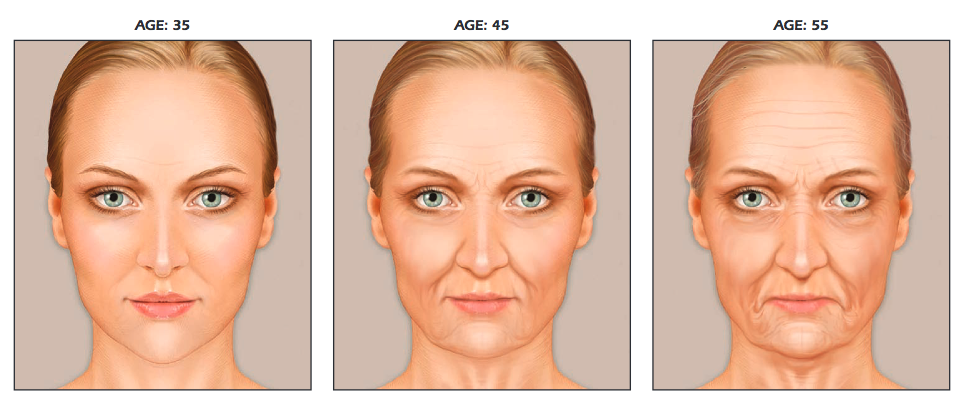
Looking at gorgeous Sophia Loren’s pictures through the last few decades, we get a sense of time travel with a front row seat witnessing a beautiful youthful face change with age. Facial aging is a fascinatingly intricate process, but our vision mostly is limited to what’s happening on the surface of the skin. Taking a closer anatomical look, scientists have discovered that a lot of major changes are happening underneath the skin too. To better understand how a visage plumped with youth, transforms into a creased and sagged poster child of age lets indulge in anatomy 101 to see closely what’s really happening underneath the skin with the passage of time.
Skin, fat, muscle and bone changes with age

Facial aging process begins second decade of life, with surface and subsurface structural changes in multiple tissue layers —including skin, fat, muscle and bone. All layers age interdependently, contributing to the overall facial appearance that keeps on changing with age.
How a face changes through time and age

Journey Of Our Skin Through Time: As we age our skin goes through several changes —on the surface the skin becomes more rough and pigmented as the epidermal renewal cycle become less efficient. Past second decade of life, skin collagen remodeling and replenishing processes begin to slow down, with progressive loss in collagen skin becomes thinner and hence more likely to wrinkle & sag. As the skin becomes progressively drier, thinner and
less elastic with age along with daily wear and tear going unchecked skin begins to wrinkle, sag and look lusterless.
Fat changes in face with age

Fat & Bone Changes With Aging: A youthful plump face has the right amount of facial fat in all the right places. Redistribution, accumulation, and atrophy of fat with age, leads to facial shape changes and sagging. Some areas lose fat e.g. the forehead, temples and upper cheeks. Other areas gain fat e.g. neck, lower face and jaw. Modification of the fat pads leads to contour deficiencies. In addition, the areas of fat tend to become farther apart. Instead of a smooth, almost continuous layer, the fat pads appear as separate structures.
Bone changes in face with age
There is a significant loss of facial bone volume with age. Aging of the craniofacial skeleton may be due to changes in the relative dynamics of bone expansion and bone resorption. Bone resorption leads to biometric volume loss. Without the structural support of bone, there are noticeable changes in the other layers of overlying soft tissue and skin.
Treatments for aging face
Age Proofing The Visage — Modern Medicine To The Rescue
Facial rejuvenation treatments can be classified in three categories:

Resurfacing Options —Skin peeling techniques can be used to modify the surface of the skin. Peeling the suface can correct the effects of photoaging, which includes correction of fine lines, irregular pigmentation and blemishes. Common skin resurfacing techniques include:
  • Chemical peels
  • Micro-dermabrasion
  • Laser resurfacing

Injectables —Injectables include a broad range of substances, which can be administered by injection into the skin, fat or muscles. Their main usage is for the treatment of lines, wrinkles and folds, as well as hollowing and volume loss. Three of the most common types include:
  • Neurotoxins
  • Traditional fillers
  • Collagen stimulators

Surgery —Surgery includes a wide range of procedures from lifts to liposuction to fat transfer. These treatments can address a range of desired outcomes. Three of the most popular surgeries are:
  • Liposuction
  • Facelift
  • Fat transfer